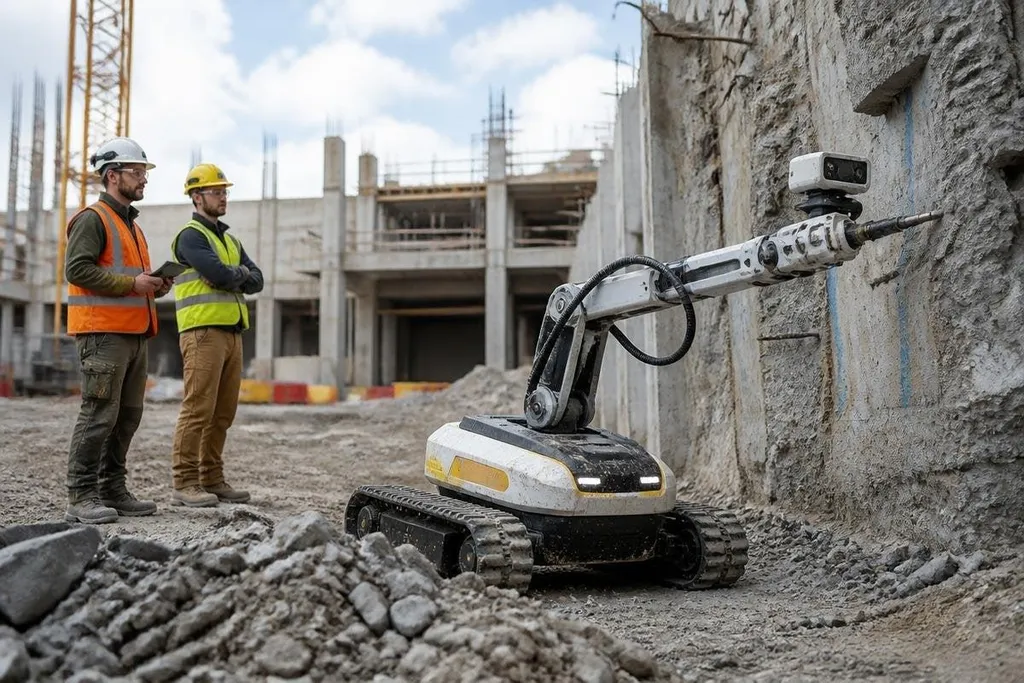
Construction robots can take on repeated work, inspect places people struggle to reach, and move materials across a site. They can also add cost and safety risk when the ground, task, or work crew changes faster than the system can react.
If you’re deciding whether a robot belongs on your site, start with the task rather than the machine. The useful question is whether the robot can do one job safely, often enough, and with less disruption than your current method.
Quick read
- Repeated work suits robots better than changing site work.
- Sensors and remote control help, but they don’t remove the need for trained staff.
- A site trial should measure completed work, setup time, stops, and repair needs.
Where construction robots help
Robots fit work with a fixed path and a clear result. Surface finishing, drilling, brick placement, surveying, cutting, and material movement can all follow set steps when the site gives the robot enough room and reliable reference points.
That repeatability can reduce strain on workers who would otherwise make the same movement for hours. It can also keep people away from some hazards, such as unstable surfaces, heavy loads, dust, or high work areas. The benefit depends on the robot completing the task without constant correction.
Inspection robots solve a different problem. A wheeled or flying system can collect images from a structure, while software can compare those images with plans or earlier records. A human still needs to check the finding, but the robot may cover areas that are slow or awkward to inspect by hand.
Robotic systems can also work during set periods when a crew cannot stay on a task. That only helps if charging, maintenance, access, and site security are planned alongside the machine. A robot waiting for a clear route is still waiting.
What makes a site difficult
Construction sites change every day.
Temporary barriers move, materials block routes, lighting shifts, and other machines share the same space. An autonomous system uses sensors and software to read its surroundings, but those tools can struggle with dust, glare, rain, poor markings, or objects outside the system’s training data.
When the work shifts to a narrow room or uneven surface, the system may need a new setup. A skilled worker may adjust in seconds; the robot may need a new map, program, tool, or safety check.
Human activity creates another limit. Workers need to pass through the area, inspect the work, and respond when something goes wrong. Clear exclusion zones, emergency stops, warning signals, and site rules matter as much as the robot’s arm or wheels.
The cost beyond the purchase price
The machine is only one part of the bill. A project may need transport cases, mounting equipment, power, software support, operator training, spare parts, and time for setup. Those costs can matter more than the purchase price when a project is short or the robot serves one narrow task.
Productivity also needs a careful measure. Count finished work, not robot motion. Record setup time, manual correction, safety stops, charging, blocked routes, and repairs. A robot that runs for several hours but needs a worker beside it for every pass may not reduce labor on the task.
A construction robot should first prove one narrow task, with setup time, worker input, and stoppages recorded. Reports from Robot24 can add the machine, work site, and test result needed before a safer trial begins.
A safer way to test one
A small trial can answer more than a polished demonstration. Choose one task with a clear output, set a fixed test area, and decide what result would justify another project. Keep a person responsible for the work area and record every stop, manual adjustment, and near miss.
I’d treat any construction robot as a site tool first and an automation project second. That view keeps the focus on completed work, worker safety, and the conditions the machine must handle.
Use this checklist before signing a purchase or trial agreement:
- Name one task: write down the exact work, surface, tool, and finished result.
- Map the site: mark routes, slopes, barriers, people, power points, and safe stopping areas.
- Set the human role: define who starts the robot, watches it, stops it, and checks its output.
- Count the full cost: include transport, setup, training, software, maintenance, and repair time.
- Record the limits: log dust, rain, glare, blocked paths, tool changes, and manual corrections.
- Choose a pass mark: agree on the output, safety record, and time saved before the trial starts.
The right construction robot is the one that handles a defined task under your site’s real conditions. If the task changes every few minutes, keep a skilled worker in charge and wait for a machine that can show more than a controlled demonstration.